
08
Aurora: The City That Learned to Rewrite Itself
Industry, history, architecture, riverfront life, and imagination converge as the City of Lights writes its next chapter along the Fox River.
From industry to imagination, the City of Lights anchors an issue about what we preserve, what we repair, what we release—and what we carry forward.
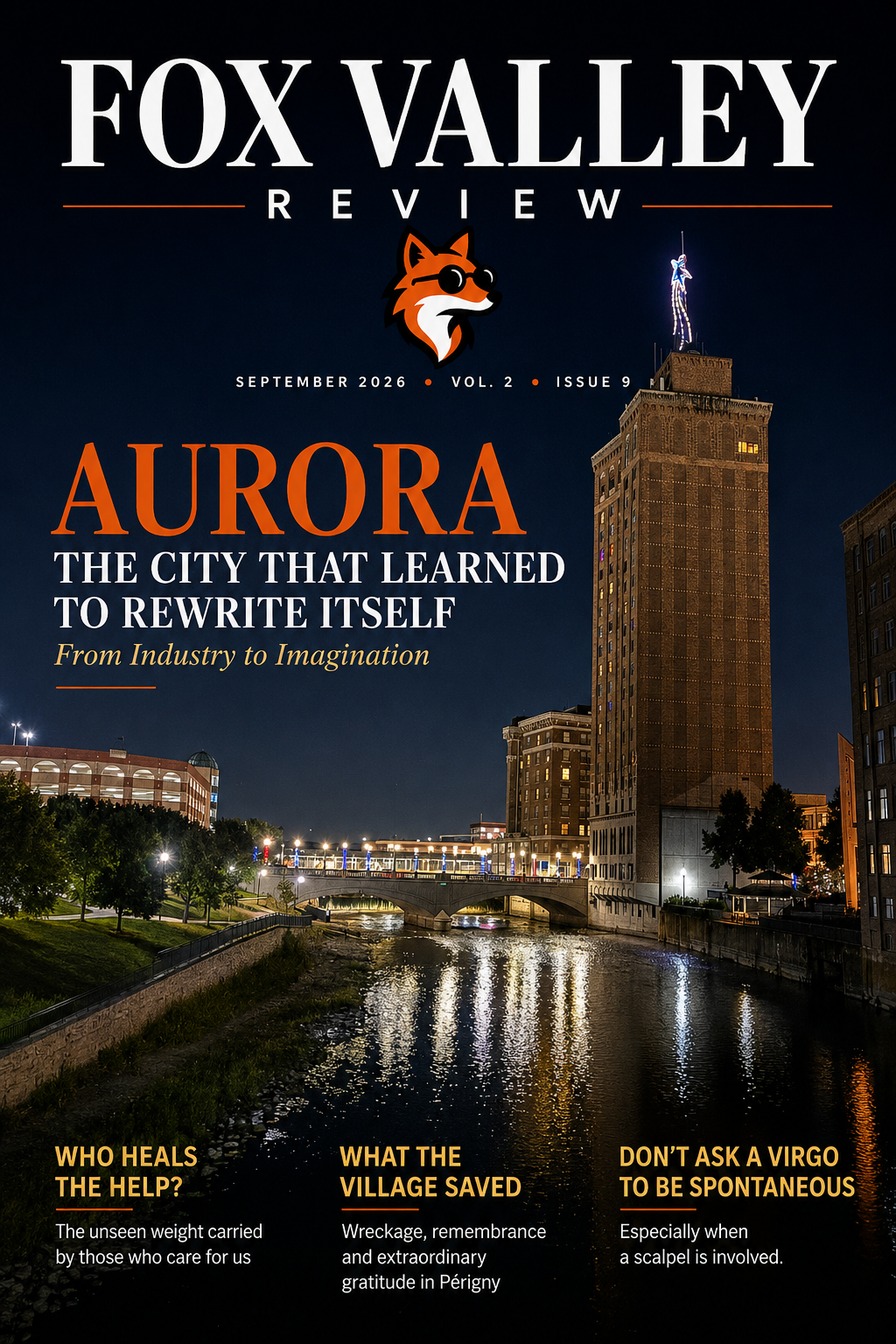
September lives between holding on and moving forward. This issue follows that tension across generations and communities: a French village transforms wartime wreckage into necessities, Granny seals summer beneath a lid, frontline professionals confront the memories they carry home, and Aurora rewrites itself without abandoning its past.
September has always felt like a month caught between two impulses. Part of us wants to hold on. The other part knows it is time to move.
Summer has not entirely disappeared. There are still warm afternoons, green lawns and evenings that stretch comfortably beyond dinner. But something has changed. School buses are back on the roads. The mornings feel different. Soon enough, the leaves will begin surrendering their green.
Perhaps that is why, looking across this issue, I kept returning to one question: What do we carry forward?
We didn’t set out to make that the theme of September. Sometimes an issue tells you what it is about only after the stories find one another.
This month, we encounter people carrying memories across generations, a city rewriting itself without abandoning its past, professionals learning what to do with experiences that follow them home, and families preserving pieces of summer for the months ahead.
There is humor here, too, because perspective matters. What feels catastrophic in one moment may look very different once we know the whole story.
And then there is movement. September reminds us that the year isn’t over simply because summer is ending. There is still time to begin something, finish something, change direction, or simply rise after a difficult season.
Perhaps that is what we do with September. We preserve some things. We repair others. We laugh at a few. We let some go. And we carry forward whatever remains worth carrying.
Thank you, as always, for reading and for allowing Fox Valley Review to keep telling the stories of the people and places around us. There is still plenty of year left.
Volume 2, Issue 9 moves from the Fox River to wartime France, from Grandma’s kitchen to a dermatologist’s office, and from childhood emergencies to the unseen burdens carried by frontline professionals.
Industry, history, architecture, riverfront life, and imagination converge as the City of Lights writes its next chapter along the Fox River.
The year is slipping by, but there is still time to leave the familiar pond behind—a playful September reminder to stop circling, start moving, and use the wings you already have.
Decades after tragedy fell from the sky over Périgny, villagers remember how wartime scarcity transformed wreckage into roofs, shoes, shelter, clothing—and enduring gratitude.
Tomatoes, cucumbers, green beans, peaches, steaming jars, and old hymns return us to a kitchen where summer was preserved one lid at a time.
A routine doctor’s appointment takes an unexpected turn, and Jake discovers that apparently even minor surgery can be spontaneous. His Virgo brain strongly disagrees.
A five-year-old screams. Dad comes flying down the stairs expecting disaster. What he finds is a wonderfully familiar lesson in the peculiar scale of childhood emergencies.
After more than three decades in healthcare, Kristen Tosaw asks an essential question about the unseen weight carried home by the people who care for everyone else.
After the storm comes the clearing sky—and the courage to rise, endure, and fly again.
Begin with the Editor’s Note, then move through reflection, remembrance, family memory, humor, frontline healing, Aurora’s reinvention, and poetry. The complete 34-page issue is available in the reader below.
Read all 34 pages below, open the September issue on Issuu, or download the complete PDF for offline reading.
If the PDF does not display in your browser, use the Download PDF button above.